The short version
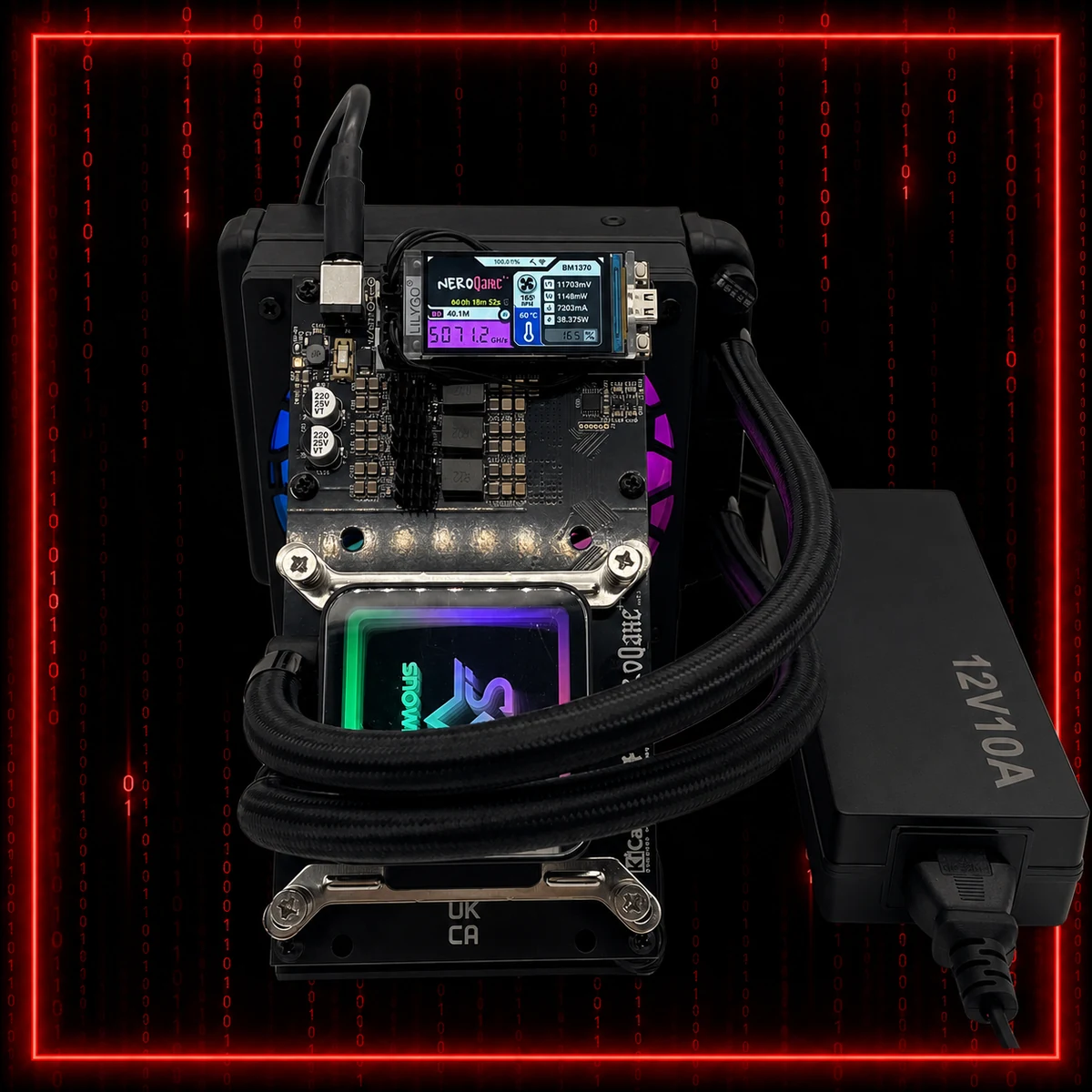
The NerdQaxe++ Hydro takes the four-chip NerdQaxe idea and gives it the cooling system it deserves. The core hashrate class remains around 4.8 to 6 TH/s, but the liquid loop changes how the miner handles sustained heat.
That matters because the machine can be making up to 6 trillion hash attempts every second. When hardware is working that hard, thermal control is not decoration. It is part of the performance story.
TH/s performance class for compact serious mining.
AIO liquid cooling with radiator thermal transfer.
BM1370 ASIC chips under stronger cooling.
Why hydro cooling matters
Air-cooled compact miners can perform very well, but heat becomes the limiting factor as hashrate rises. The Hydro model changes the thermal path by moving heat away from the ASIC assembly through a liquid-cooling loop and radiator.
The result is not just a different look. It can create better sustained temperature control, less dependence on aggressive fan speed and more confidence when running longer sessions.
What the hashrate means
At 4.8 to 6 TH/s, the NerdQaxe++ Hydro is attempting roughly 4.8 to 6 trillion SHA-256 calculations every second. That puts it in a serious compact-mining class.
The Hydro model is especially interesting for miners who care about tuning. Better cooling can give more headroom for careful frequency and voltage experiments, but stability still beats short-lived headline numbers. The overclocking guide explains the cautious approach.
Power draw in real life
The Hydro model uses more supporting hardware than a tiny single-chip miner, including the liquid loop and radiator system. Exact draw depends on the operating profile, pump, fans, voltage and frequency.
Think of it as compact enthusiast hardware rather than a silent gadget. It is still far below industrial ASIC territory, but it should be placed where airflow, cable routing and heat output are treated seriously.
Best use case
The NerdQaxe++ Hydro is best for a miner who wants the 4.8-6 TH/s class but also wants stronger thermal control. It suits longer sessions, warmer rooms, careful tuning and setups where noise and heat management matter.
If the air-cooled NerdQaxe++ is the practical power upgrade, the Hydro is the enthusiast version: more complex, more interesting and better prepared for sustained heat.
| Category | NerdQaxe++ Hydro |
|---|---|
| Algorithm | SHA-256 Bitcoin mining |
| ASIC | 4 x BM1370 chips |
| Hashrate class | Approx. 4.8 to 6 TH/s |
| Performance feel | Up to around 6 trillion hash attempts per second |
| Cooling | AIO liquid cooling with radiator-based heat dissipation |
| Best buyer | Home miners who want strong compact hashrate with better thermal headroom |
Strengths
- Better thermal control: liquid cooling helps move sustained heat away from the mining hardware.
- Serious compact performance: 4.8-6 TH/s is a meaningful home-mining class.
- Tuning potential: stronger cooling gives more room for careful experimentation.
- More refined setup: cooling is not relying only on direct high-speed airflow across the ASICs.
- Visual appeal: it looks like specialist hardware, because it is.
Limits
- Hydro cooling adds complexity: pump, radiator, tubing and placement all matter.
- It uses the older generation BM1370 chip, not the new generation 1373 chip.
- It is more involved than a starter Bitaxe or simple air-cooled miner.
- Cooling headroom is useful, but it does not remove the need for careful settings and stable power.
Verdict
The NerdQaxe++ Hydro is the better choice for miners who care about sustained performance and thermal control.
It is not just about raw hashrate. The value is in the cooling platform: better heat movement, better tuning headroom and a more serious home-mining feel.
If you want simple, the air-cooled NerdQaxe++ is easier. If you want the more capable and more interesting version of the 4.8-6 TH/s class, the Hydro model is the one to look at.
Next steps
Start with setup, then read the overclocking and BM1370 comparison articles before pushing settings harder.
Setup Guide Overclocking Guide